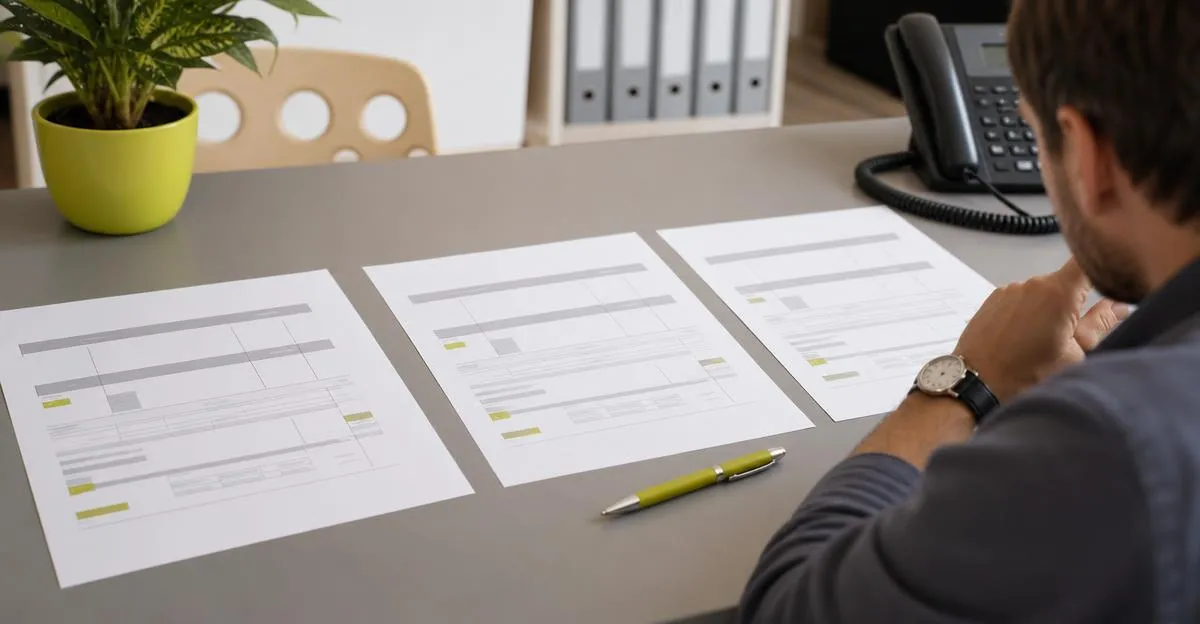
AI answering services look alike on the pricing page and differ in the lines of the contract. Six points tell you whether one is worth it: how the minutes are counted, who keeps the number, and how hard it is to walk away.
How the minutes are counted
Almost every price list starts with a bundle of included minutes. Ask three questions before you even look at the price: whether time is billed by the second or rounded up to the minute, what one minute over the bundle costs, and whether ten second wrong numbers are counted at all.
To size it up: a booking call runs 40 to 90 seconds, and a small business almost always lands between 100 and 300 minutes a month. Rispondly keeps a flat fee, Base at 69.99 euro and Pro at 129.99 euro a month plus VAT.
Who keeps the number
Your business number is printed on flyers, it sits inside your Google profile and it lives in the phone of every regular. Be wary of a provider that wants it registered in its own name to switch the service on: the day you change your mind, getting it back becomes a negotiation rather than a ten minute job.
The clean route is a different one: the line stays registered to you and you set the forwarding from the handset yourself, with *21*NUMBER# for a permanent divert. No change of ownership, no paperwork with the carrier, and proof that the provider does not need your number in order to work.
When a person has to answer
A good service knows when it is not the right place for a call. Ask how the handover to a person is configured: which number the call goes to, during which hours, and what happens when nobody picks up there. Without a written rule, the customer with a real problem stays with the machine.
Outside opening hours the rule changes: the assistant takes the name, the reason and the number and passes them to you. Ask how long it takes for that message to reach your phone, because an emergency you read the next morning is no longer an emergency.
Languages, and a test call of your own
The list of languages on the website is not the point, who picks the language mid call is. The Rispondly assistant opens in Italian and carries on in the caller's language when he switches to English, German or French, with no menu and no keys to press.
Then test it yourself. Ask for a trial number and call from the shop floor with the noise around you: ask a price that is not on the website, a Sunday opening time, a service you do not offer. Three minutes tell you whether it learned your price list or is reading a script.
Where the data lives and what the caller hears first
Ask where recordings and transcripts are stored, for how long, and who can open them. Anyone handling your customers' data has to sign a processor agreement under article 28 of the GDPR: a document attached to the contract, not a reassurance given over the phone.
If calls are recorded, the caller has to be told at the start, with the purpose and the retention period. From August 2026 the AI Act adds the duty to state that the other side is an automated system: it has to be said up front, not buried in the terms.
How you get out
Read the end of the contract before the beginning: minimum term, notice period, monthly or yearly billing in advance, setup fees that never come back. A service that works does not need to tie you down for twelve months.
Ask what you take with you on the last day as well: appointments, contacts and transcripts should export into a file. The rest takes you ten seconds, cancelling the forwarding from the handset with ##21# or ##61#.